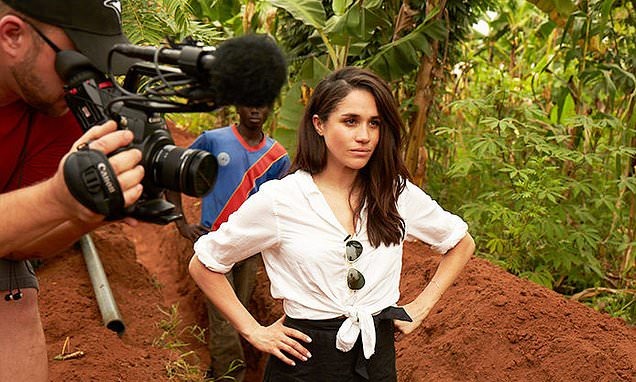
New revelations about Meghan Markle’s visit to Rwanda have resurfaced, sparking debate over the true intentions behind her involvement with the charity World Vision.
Critics argue that her trip, initially framed as a humanitarian effort, has come under scrutiny amid allegations of sexism and racism plaguing the organization’s British division, which it has denied.
Markle’s connection to World Vision dates back to January 2016 when she agreed to participate in a film project spotlighting the charity’s work in providing clean water to communities in the African nation.
However, royal biographer Tom Bower claims that the visit was as much about self-promotion for the Duchess of Sussex as it was about philanthropy.
According to him, her meticulous planning included a wardrobe change for every photo opportunity with local children, leading to questions about the genuineness of her outreach.
Bower details in his book, Revenge, that Meghan landed the role after a swift agreement that she would participate, later accompanied by a list of extravagant demands.
Notably, these included first-class flights, a professional hair and makeup team, and a dedicated photographer, all of which significantly inflated the project’s budget.
What raises eyebrows is the claim from Bower that Meghan’s demands prompted the original film producer Brenda Surminski to withdraw from the project.
Surminski expressed her disbelief at how a photoshoot in a struggling village had been choreographed for celebrity appeal, characterizing it as an opportunistic move by Markle to bolster her own image as a philanthropist.
Previously, on her now-inactive blog, The Tig, Meghan reflected on the challenges of balancing her glamorous life with her work in less fortunate settings.
Despite these sentiments, Bower’s account proposes a stark contrast to her public persona, suggesting that her actions were more aligned with personal gain than genuine humanitarian concern.
The Duchess’s relationship with advertising executive Matt Hassell was also highlighted by Bower as a factor for her appointment with World Vision.
Hassell, who was enamored with her, advocated for her inclusion as the charity’s global ambassador, framing it as somewhat of a personal victory following her contentious departure from the UN Women role.
During her earlier stint with UN Women, Meghan faced criticism for her advocacy and a speech she gave that was accused of plagiarism.
Following this fallout, her efforts to enhance her status as a women’s advocacy leader were met with resistance, leading her to seize the opportunity with World Vision as a means to reassert her philanthropic image.
Upon her arrival in Rwanda, the documentary’s portrayal of her dedication to the charity was juxtaposed against reports of excessive demands and strategic photo options.
Bower paints a picture of the visit that complicates the narrative of a humble humanitarian at work.
Instead, he suggests a concerted effort to craft an appealing public image, as evidenced by her extensive preparations, including bringing multiple outfits to the impoverished area.
After her return to Canada, Meghan leveraged her Rwandan experience for a fundraising art exhibition—displaying children’s artwork in a bid to secure funds for another clean water well.
This blurred the lines between genuine charitable intent and personal branding in the eyes of some critics.
Back in the present, World Vision’s UK division has recently faced serious allegations, as former and current employees allege a toxic workplace culture characterized by racism and sexism.
These claims have surfaced amidst a broader narrative questioning the integrity of organizations that position themselves as charitable but fail to foster inclusive environments internally.
The charity has firmly rejected the accusations, insisting that they stem from a “small number” of disgruntled former staff members amid layoffs and restructuring efforts.
The Charity Commission is now reviewing these allegations but has acknowledged World Vision’s reports on the contentious workplace culture.
As the debate surrounding Meghan Markle’s involvement with World Vision continues, it highlights the complexities of celebrity philanthropy.
Can high-profile figures genuinely contribute to humanitarian efforts while maintaining their brand image?
Or do their endeavors often become tangled in self-interest and public relations strategies?
Meghan’s Rwandan trip undoubtedly invites further inquiry into these pressing questions about altruism and authenticity in charitable work.