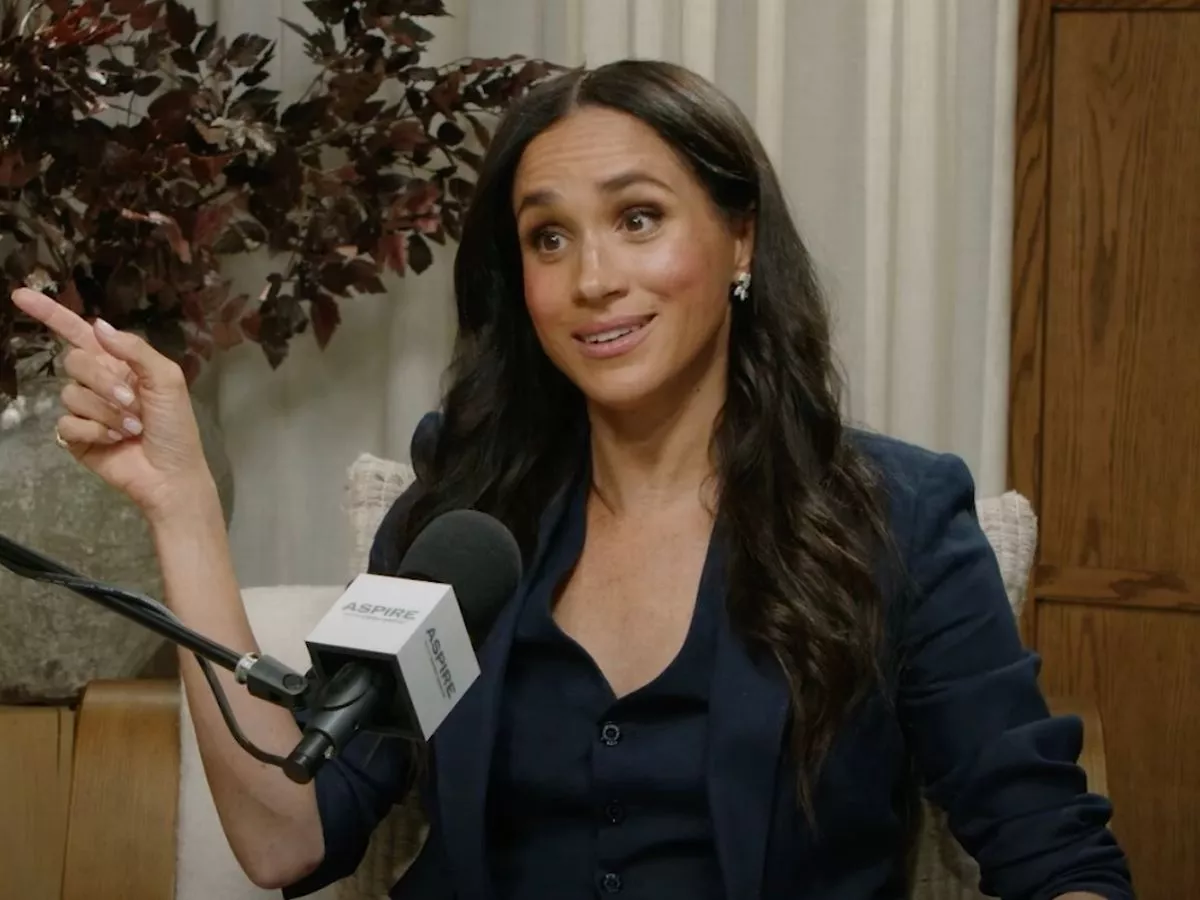
Meghan Markle has stirred the pot once again with her recent comments during an appearance on Emma Grede’s podcast, Aspire with Emma Grede.
During the discussion, the Duchess of Sussex opened up about her experiences as an entrepreneur and shared insights into her personal life.
However, a particular question about her public image led her to assert that she wishes people would begin telling the truth, which some interpret as a jab at the royal family.
When asked if she could rewrite her public narrative, Markle stated, “Yes, I would ask people to tell the truth.”
This statement has caught the attention of royal commentators, who didn’t hesitate to label her as a “liar.” Experts argue that Markle has constructed her entire persona around what they perceive as exaggerated claims regarding her experiences with the monarchy.
Royal analysts Hugo Vickers, Samara Gill, and Matt Wilkinson tackled Markle’s comments on The Sun’s Royal Exclusive.
Gill was particularly outspoken, deeming Markle a “constant liar.”
She contended, “Her whole brand is built on a spin of lies,” expressing skepticism about the authenticity of Markle’s words.
For her, asking others to reveal the truth is not only hypocritical but also reflects poorly on Markle’s character.
Expanding on the conversation, Vickers aligned himself with Gill’s sentiments, suggesting that the truth about Markle often comes from those who have been directly involved with her.
He reminisced about how Markle’s notoriety primarily stems from her marriage to Prince Harry, implying that without that connection, her impact would be significantly diminished.
In her podcast exchange, Meghan was asked by Grede whether she felt angered by those who spread falsehoods about her.
Markle recounted advice from her close friend Serena Williams, who told her, “A lie can’t live forever.”
This philosophy seemed to resonate with her as she reflected on her public persona over the years.
While she asserted her desire for truth, her critics argue that she has also propagated her share of misleading narratives.
During the podcast, Meghan also revisited moments from the past, including a widely-publicized and criticized twerking video that surfaced while she was pregnant.
She defended the video, describing it as a representation of her “real, authentic, fun life” that continues behind the media’s glare, implying that there’s more to her story than what’s typically portrayed in the tabloids.
Her recent entrance back onto social media has led Markle to express her gratitude for the freedom it brings, allowing her to communicate on her own terms.
This sentiment seems to mark a significant shift for the Duchess, as she is now leveraging platforms to express her truth and interact with her followers more directly.
The backlash against her statements was swift.
Critics were quick to highlight the apparent contradictions in her messaging, wondering how someone who has faced numerous allegations regarding her own truth could challenge others to be more honest.
Many royal commentators suggested that her brand hinges on constructed narratives rather than straightforward honesty.
In discussing the fallout from her remarks, some royal experts hint at a “revolving door” of staff who have left her employment, suggesting that their experiences might shine a light on dynamics not usually visible to the public.
Issues concerning bullying allegations have been raised in connection to Markle’s handling of her team while living in the U.K., further complicating her assertions about seeking truth.
Meghan’s comments raise an interesting point about public perception and accountability.
By portraying herself as a victim of misinformation, she attempts to steer the narrative in her favor.
However, the situation illustrates a broader dilemma about celebrity culture and the extent to which personal experiences are intertwined with public personas.