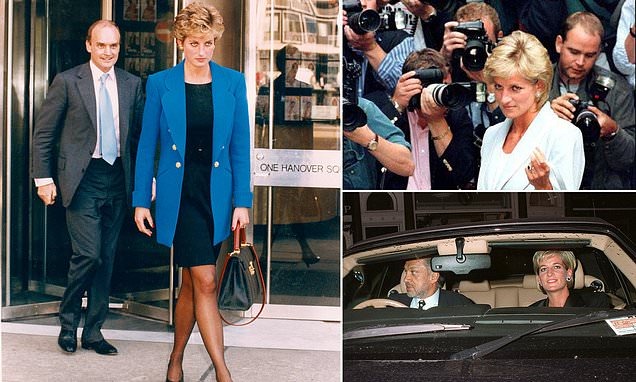
Princess Diana remains a figure shrouded in myths and fascination, especially when it comes to her complex dance with the press.
Recent revelations suggest that she sometimes tipped off journalists about her whereabouts, seemingly contradicting her public claims of being hounded by the media.
While many have attributed her interactions with the press to an earnest desire to protect her privacy, one royal commentator offers a different interpretation, hinting at a deeper motivation rooted in jealousy.
In her 2022 biography, The Palace Papers, author Tina Brown delves into the multifaceted legacy of Diana, emphasizing how her celebrity status transformed the royal family.
Intriguingly, Brown argues that Diana used her public persona as a tool to influence and exasperate the men in her life, orchestrating scenarios that would provoke jealousy.
For instance, the now-iconic image of Diana passionately kissing Dodi Fayed on a Corsican beach wasn’t just a candid capture; it was a calculated move, reportedly orchestrated by Diana herself to send a message to her former lover, Hasnat Khan.
Considered one of the most photographed women in history, Diana understood the power of her image.
Former Condé Nast chairman Nicholas Coleridge recounted a memorable luncheon during which he invited Diana in 1996, shortly after a provocative photo of her surfaced in a tabloid.
Coleridge expected a cancellation, fearing the scandal, but she surprised him by confirming her attendance and even referenced the very photo that had captured so much attention.
In a moment of candidness, Diana asked Coleridge for his opinion on her body.
She bluntly inquired, “Nicholas, please be frank, I want your real view.
Are my breasts too small, do you think?” Coleridge was taken aback but quickly assured her that there was nothing to worry about.
Just as he walked her to her car, a throng of paparazzi awaited, a reminder of her complicated relationship with the media.
What’s fascinating here is how Diana navigated her dual role as a royal and a media magnet.
Brown notes that this behavior exemplifies Diana’s enigmatic character, describing it as “tricky” and “seductive,” comparable to modern-day celebrity tactics employed by figures like Harry and Meghan.
However, she asserts that Diana’s strategies were far more deliberate and thought-out.
Diana’s pattern of informing the press of her movements didn’t end with her relationship with Dodi.
When she was dating businessman Gulu Lalvani, images of the couple appeared shortly after she allegedly tipped off the media.
This raises the question: how much control did she want over her narrative, even while appearing to lament the intrusion?
The dynamics don’t stop at her romances.
Diana, who publicly decried former lover Major James Hewitt for participating in a tell-all book about their affair, seemed to play both sides of the media game.
Despite public outrage, she was said to have encouraged Hewitt to cooperate, seeking to shape the story in a way that would garner sympathy rather than scorn.
Moreover, the fallout from her tumultuous marriage with Prince Charles seemed to fuel her media maneuvers.
According to photographer Darryn Lyons, Diana hinted at her husband’s infidelity long before it became public, subtly guiding the narrative.
It’s revealing of how she leveraged the media landscape to address her life’s complexities, bypassing typical royal constraints.
The relationship between the royals and the press has continued to be fraught.
Her sons, Prince William and Prince Harry, have both demonstrated how personal experiences with the media have shaped their current attitudes.
While William takes a more restrained approach, focused on protecting his family’s privacy, Harry has been vocally critical, suggesting a generational divide in how they handle potential intrusions.
The controversy surrounding both William and Kate when their intimate photos were leaked comes to mind, invoking memories of Diana’s tragic death amidst a barrage of paparazzi.
The irony is palpable; the very attention that once amplified Diana’s image also played a role in her demise.
Despite their disdain for tabloid culture, one can’t help but acknowledge how similar tactics continue to shape the royal narrative today.
Brown summarizes this tangled legacy suggesting that the royal family’s relationship with the press is still heavily influenced by Diana’s dual need for privacy and engagement.
In examining Diana’s relationship with the media, we see not just a story of a royal figure but a broader commentary on fame, control, and vulnerability.
The relationship she fostered with the press remains as intricate and captivating as the woman herself, underscoring the enduring dilemma of life under the public’s gaze.
Her legacy is a poignant reminder of the power—and peril—of the spotlight in shaping one’s story.