


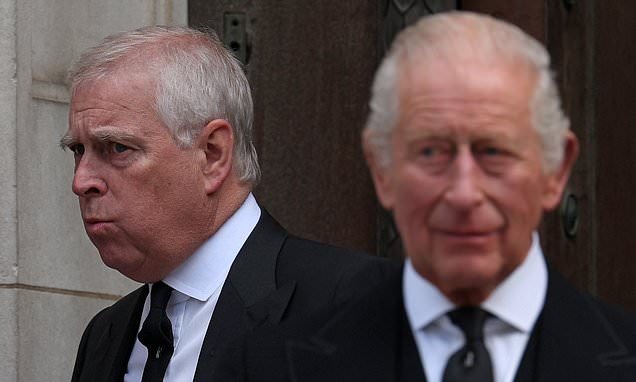
In a dramatic turn of events, King Charles placed family duty over personal bonds, decisively confronting his brother, Prince Andrew.
Sources reveal that the King made it clear: Andrew had to voluntarily relinquish his title of Duke of York, or Charles would resort to more formal measures to strip it away.
Finally bowing to the pressure, Prince Andrew issued a formal statement on October 17, announcing he would no longer use his ducal title.
While many anticipated this announcement, it followed a significant ultimatum from the King, aimed at safeguarding the Crown’s reputation amid swirling controversies that had encircled Andrew for years.
In his carefully crafted statement, Andrew attempted to project a sense of dignity.
He articulated that the ongoing accusations were a distraction harmful to the royal family’s work and expressed his willingness to prioritize his obligations to the monarchy.
“After discussions with the King and my family,” he noted, “I have decided to step back further, relinquishing my title and honors.”
Yet, underscoring Andrew’s position was a lingering air of concession, even as he reiterated his denial of the allegations against him.
Leading up to this pivotal moment, insiders suggest that discussions between the brothers were fraught with tension.
According to reports from the Daily Mail, King Charles made it unmistakably clear: if Andrew refused to step away amicably from the dukedom, he would not hesitate to pursue a parliamentary solution to enact the title’s removal.
Although the King preferred to avoid a public spectacle, his patience had limits—culminating in an unavoidable confrontation.
For Andrew, the pressure had been mounting for some time.
The resurfacing of a controversial email from 2011 seemed to be the final straw.
In this email, he had reassuringly told Jeffrey Epstein, “we’re in this together,” a remark that brought renewed scrutiny and condemnation upon the Prince and his associations.
This recent scandal was a decisive moment for Charles and the royal household.
A source reported that when the reckoning arrived, it came swiftly and with little mercy.
“Andrew might have misread the situation,” the source remarked, “but the Palace was acutely aware of the stakes.”
Moreover, heightened scrutiny loomed in the form of Virginia Giuffre’s upcoming posthumous memoir, set to be released on October 21.
Giuffre tragically ended her life in April after accusing Andrew of sexual assault—claims he has always firmly denied.
Her memoir is anticipated to revisit her allegations and detail her harrowing experiences within the oppressive culture surrounding Epstein.
In light of these developments, another royal source suggested that Andrew’s decision was ultimately a rational one.
Realizing that holding on to his title while the family faced ongoing scrutiny became untenable, he opted for restraint.
The thought of continuing to wield his titles while alternatives were enacted proved to be too much to bear for the broader royal family.
As these events unfolded, many began to reflect on the deep-rooted complexities and pressures that accompany royal life, especially when marred by controversy.
The royal family is often veiled in a protective aura, yet this incident showcases the turbulent undercurrents that can threaten their stability.
The King’s uncompromising stance has sent a clear message: the monarchy must be viewed as above reproach, even if it means making difficult decisions within the family.
As they navigate this evolving landscape, the royal family appears to be taking significant steps to mitigate any further reputational damage.
For those navigating personal struggles in light of these issues, resources are available.
Individuals facing the trauma of sexual abuse or suicidal thoughts are encouraged to reach out for support—there’s help, and you’re not alone in this fight.