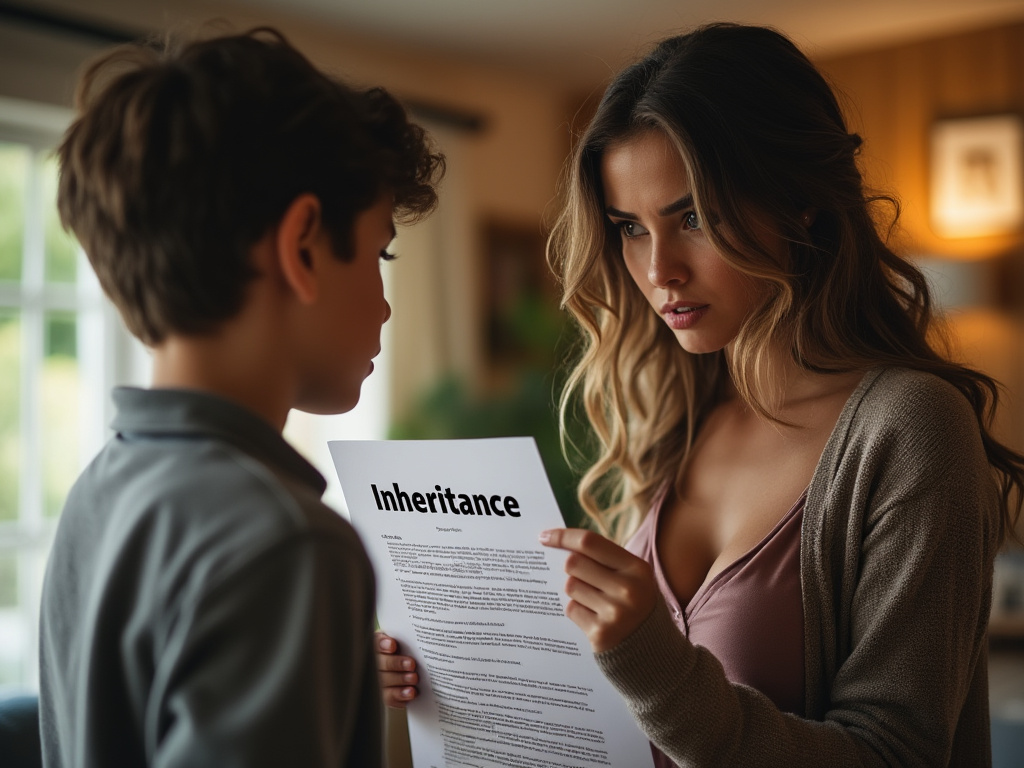
It was a day like any other when fate twisted its knife deeper into my chest. Just months ago, my life brimmed with love and laughter.
At thirty-five, I was beginning to lay the bricks of my future, tinted with the warmth of family bonds. But then, my world shattered—my parents perished in a car accident, leaving behind not just grief, but an inheritance that felt more like a burden than a blessing.
In the haze of loss, I found myself thrust into a legal labyrinth. As their only biological child, the entirety of their estate was poised to dissolve into my hands once the solicitors cleared their throats and tied up loose ends.
Among the untidy piles of paperwork, the absence of a will loomed large, an inexplicable oversight that sent my mind spiraling. Owning properties, collecting investments—their life was a canvas of opportunities, and now, it seemed that the brush rested solely in my palm.
How could they leave me such a daunting legacy without any guidance? But tangled in this inheritance was Ben, a boy who had, for over a decade, called my parents his own.
Ben, who had entered our lives at five years old, became the shadow of joy that twinkled in their eyes. He was never adopted—he was a “Looked After Child” within the confines of the fostering system.
Legally, Ben wasn’t my brother; yet, somehow, he felt like family. As I grappled with my grief, Ben’s image swirled in my mind, reminding me just how intertwined our lives had become.
Despite our familial ties, he and I had never truly bonded. By the time my parents welcomed him, I was growing up, living independently and exploring my world, while he remained in the shelter of our family home.
My empathy for him was real, yet it felt distant—an ache I couldn’t fully embrace. The thought of sharing my inheritance with him was like trying to pull a thread from an old sweater—the implications stretched far and unraveled tangentially into complex territory.
I could faintly recall the conversations my parents had about their commitment to Ben, their dreams of nurturing him into an adult who would flourish in the world. My girlfriend, Sarah, seemed to grasp the emotions wrapped around this loss more than I did.
She regarded Ben as some sacred vestige of my parents’ love, insisting that I should share a portion of the inheritance with him. “He’s lost so much,” she said one evening, her voice trembling with compassion as we sat across from each other at our small kitchen table, her hands wringing the cloth napkin as if it were my past.
“What would your parents want?” she asked, her eyes reflecting her unwavering sincerity. “He deserves more than just his ISA. You know that.”
My pulse quickened at the prospect. I didn’t know if sharing was “the right thing” but, considering my own future, a pang of resentment gnawed at the edges of my heart.
Should I risk my independence for the sake of someone I didn’t truly know? “Ben is entitled to the ISA,” I declared, each word coming heavier than the last.
“What I’m left with isn’t even finalized yet!” My voice caught, frustration washing over me as I turned away, the impending grief threatening to drown me in a sea of sudden responsibility. Deep down, I felt the rage of unfairness toward my parents’ choices, their absence now forcing me to bear the consequences of policies I hardly understood.
In the weeks following our outburst, grief morphed into something unsettling: confusion. I lived half-adrift, torn between the echoes of my parents’ legacy and the weight of looming, legal entanglements.
Then, I was forced to confront the ugly truth: there was no way to ignore how much Ben existed at the heart of this mess. I decided I needed clarity.
After a grueling visit to the solicitors, I learned that Ben had accumulated a notable sum in the ISA, nearly £100,000, once he turned 18. It struck me cold; he would be financially stable, perhaps better off than I was right now.
Yet, the thought of him being so close to being on his own—still alone—made my stomach churn. But what was the right course of action?
Was it my responsibility to support him, or did I owe it to myself to build my future first? No amount of legalities or finances could untangle how I felt; I was still reeling from trying to define a relationship that had never fully been forged.
We held onto conversation as the grief evolved from raw to reflective. Sarah’s words lingered hauntingly, and I reluctantly asked myself what my parents would have thought.
A part of me believed they would want me to reach out to Ben and offer the support they could no longer provide. “I’ll still be there for him,” I resolved internally.
“But I need to secure my future.”
As I made my decision to keep contributing to Ben’s ISA, a sense of peace washed over me. Yes, I would set aside a small portion of my inheritance to establish a trust for him.
It wasn’t charity; rather, it was an acknowledgment that I could contribute to his future without losing my footing. Yet, that didn’t mean I’d cut ties.
Reaching out to Ben’s social worker felt right too. Ensuring he had a stable support network now, while remaining emotionally present in his life, was a commitment I was willing to make.
Family wasn’t merely about blood; it was about showing up for each other. As the acceptance of my parents’ loss settled in like a late evening fog, I found purpose within the shadows of grief.
I wasn’t just fighting for my future; I was stepping into the role of an anchor for Ben, too. As we walked forward into a world that would never be the same, I learned that love is tangled, intricate, and sometimes painful—but it is also resilient, capable of surviving even the darkest of storms.
In the silence of my parents’ absence, I found the voice of my conscience, guiding me towards a path untraveled. “Take care of him,” they seemed to whisper.
And perhaps, just perhaps, with each step I took toward Ben, I was also reaching out to them, honoring their legacy one choice at a time.